
The Youngest Stroytellers
20th July 2026
Words: Ben Seymour
Photos: Ben Seymour
Every family archive is full of children. They are, in a real sense, what the archive is for - the first steps, the school plays, the gap-toothed grins, kept safe for the adults those children will become. But look closely at almost any family's photos and stories online and you'll notice something: the children are always the subject, never the author. Everything about them; nothing by them.
We thought that was worth fixing. Carefully.
A byline without an account
From today, Storyus supports junior authors: a way for a child under 13 to have their stories told under their own name, inside their family's collective - without an account, an email address, or a password of their own.
A junior author is created by a parent or guardian, and creating one means something: you tick a box that says, in plain words, I am this child's parent or guardian, and I accept responsibility for what is shared under their name. That acceptance is recorded the same way we record your acceptance of our terms - provably, with a date. Other guardians can be added, and each must accept the responsibility themselves; it can never be handed to someone who didn't agree to carry it. Grandparents, co-parents, blended families - guardianship here is a list of people who said yes, not a single owner.
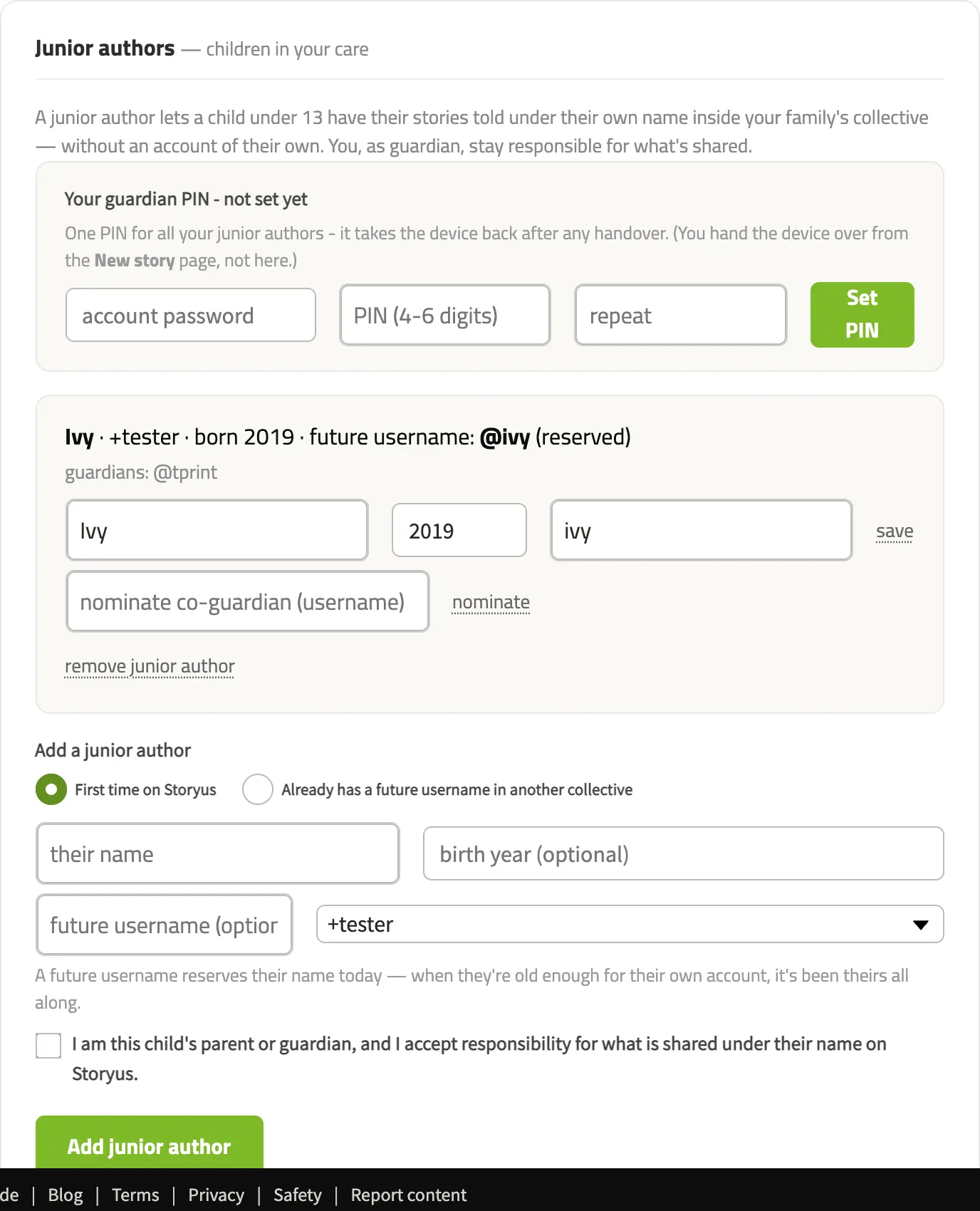
What we deliberately don't collect matters as much as what we do: a junior author is a display name and, if you choose, a birth year. That's the whole record. No date of birth, no photo requirement, no profile. Children appear in Storyus the way they appear in a family album - through what the family chooses to tell.
Handing over the pen
Here's the moment this was all built for. You're on the New story page, about to make a postcard, and your daughter says can I do it?
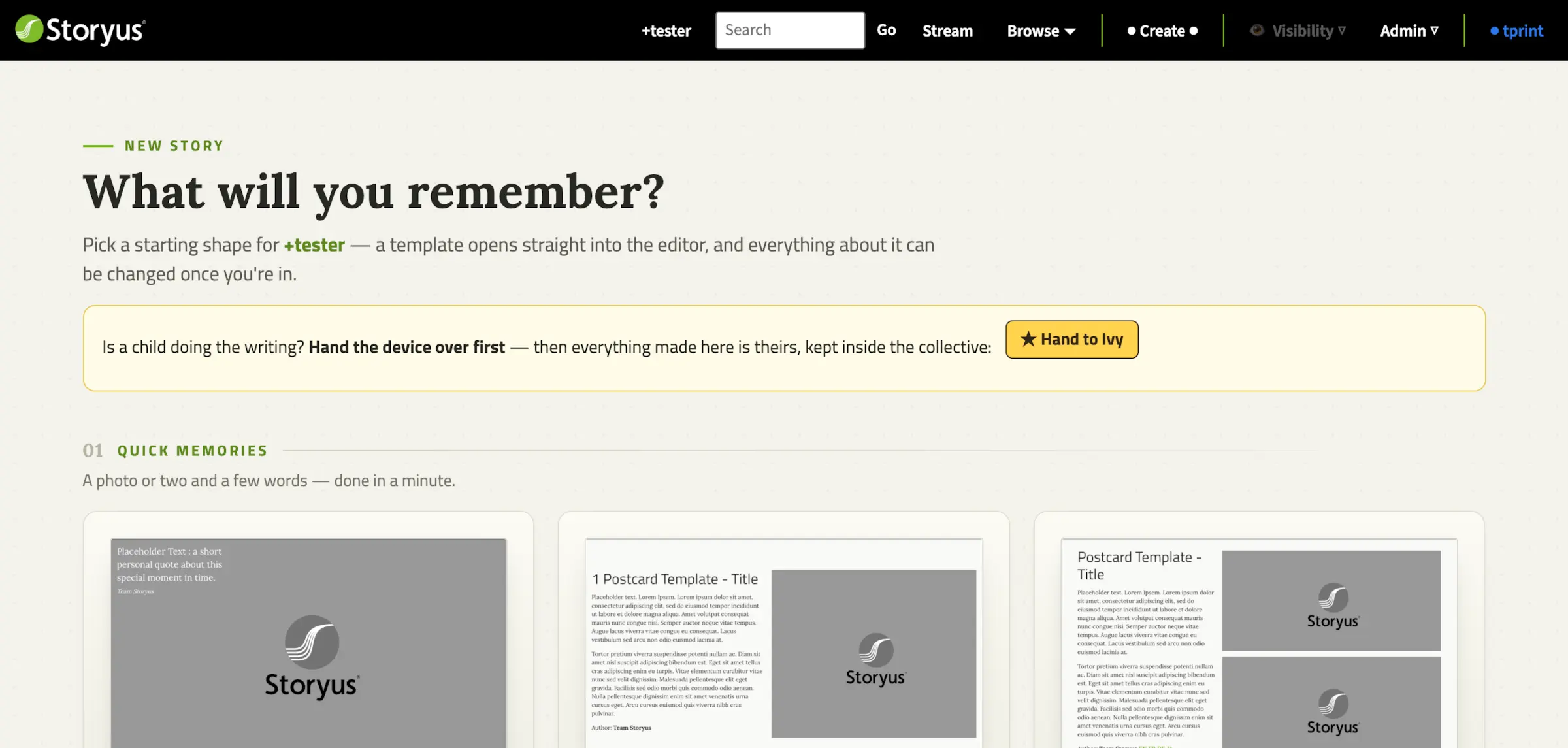
You tap Hand to Ivy.
From that moment the device is hers. A bright yellow bar appears at the bottom of every page - Junior Mode: Ivy is using Storyus - and the whole place quietly rearranges itself around young hands. The menus shrink to stories, browsing and creating. The story types narrow to the ones that suit her - moments, postcards, essays, reflections, join-the-dots. The publishing choices collapse to two: just for her, or for the family. Everything administrative, everything grown-up, everything that could reach beyond the family - gone, and not just hidden: refused by the server itself, whatever a clever child does to the page.
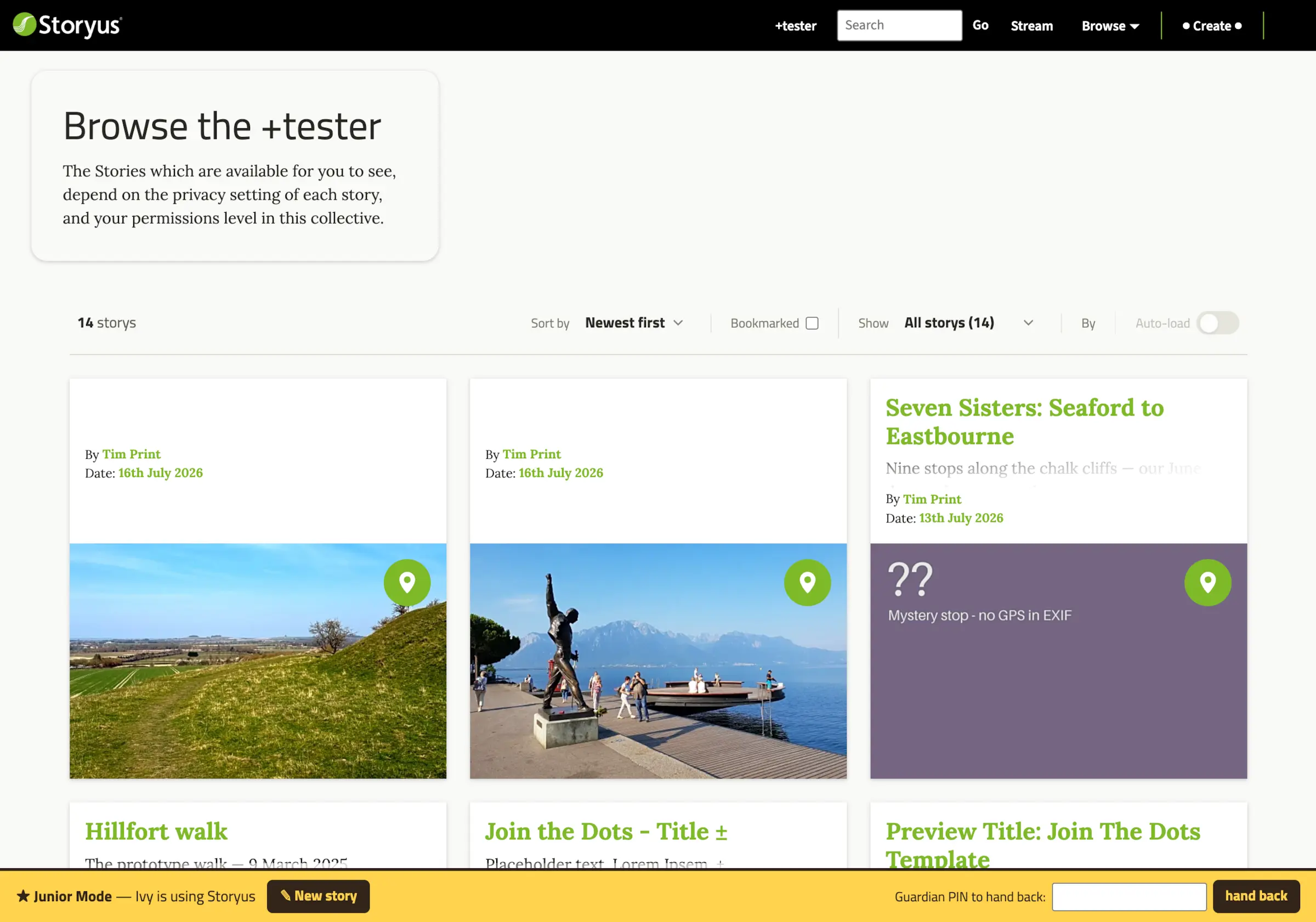
Getting the device back is your side of the bargain: a guardian PIN, set once, asked for in the yellow bar. Handing over is one tap; handing back is deliberate.
Safe by architecture, not by promise
The rules underneath are simple to say and firm in the code:
- A story written in Junior Mode belongs to the family. It can be private or collective-visible, and the collective is as far as it goes.- A child's byline never appears on the public internet. Even when a grown-up later shares a child's story more widely, it stops short of public - always.- Reading is shaped too. In Junior Mode the archive shows a child their family's stories through a member's eyes - not your drafts, not your private pieces, not the wider internet-facing corners of Storyus. And any story a grown-up marks Hide in Junior Mode simply isn't there: not in browsing, not by link, not by search. Families know their own texture - the joke that lands at the adult table, the story about a hard year - and one small tick keeps it for later without deleting it from the record.
None of this is a settings page you have to get right. It's how the system works.
A name, waiting
Here is our favourite part, and the one that says most about what Storyus is for.
When you create a junior author, you can reserve their future username. Ivy, aged six, can have @ivy set aside today - and from that moment, nobody else can register it. Her stories carry her name now; her username waits for her.
Families are bigger than one collective, and children usually belong to several - a parents' archive, a grandparents' one. Junior authors can exist in each, and their guardians can link them together as one child, so that her stories are hers everywhere the family writes. A link is only ever made by her own guardians; it's a claim about a child's identity, and we treat it that way.
And the long game: everything a junior author makes is recorded as theirs - authored by them, kept under their name, distinct from the grown-up who held the account. The design looks ahead to the day she's old enough for an account of her own, when the name that waited becomes the name she signs in with, with her whole authored childhood already attached to it. We built the record for that day from the first postcard.
Real stories, from real people, at every age
One more thing carried through from our community rules: Storyus is an authentic record, at every age. What a child makes here is human-made - their words, their photographs, their slightly sideways view of the family dog. That's the point. The first story ever published by a junior author on Storyus was a postcard, made with the default settings in about a minute, about someone who kindly shared their pizza crust. It ended woof woof.
That's the archive we want to be keeping.